a

a
CLICK PHOTO TO LINK TO OFFICIAL WEBSITE

Disclaimer

DISCLAIMER: It’s important to note that the posts in this page are NOT intended to be a medical reference or to replace professional care during pregnancy, labor, or birth.

Sunday, 23 March 2014

Breast Compression


The purpose of breast compression is to continue the flow of milk to the baby once the baby no longer drinks (open-pause-close type of suck) on his own. Breast compression simulates a letdown reflex and often stimulates a natural letdown reflex to occur.
The technique may be useful for:
1. Poor weight gain in the baby
2. Colic in the breastfed baby
3. Frequent feedings and/or long feedings
4. Sore nipples in the mother
5. Recurrent blocked ducts and/or mastitis
6. Encouraging the baby who falls asleep quickly to continue drinking
Breast compression is not necessary if everything is going well. When all is going well, the mother should allow the baby to "finish" feeding on the first side and, if the baby wants more, should offer the other side. How do you know the baby is finished? When he no longer drinks at the breast (open-pause-close type of suck).

It may be useful to know that:

1. A baby who is well latched on gets milk more easily than one who is not. A baby who is poorly latched on can get milk only when the flow of milk is rapid. Thus, many mothers and babies do well with breastfeeding in spite of a poor latch, because most mothers produce an abundance of milk.
2. In the first 3-6 weeks of life, babies fall asleep at the breast when the flow of milk is slow, not necessarily when they have had enough to eat. After this age, they may start to pull away at the breast when the flow of milk slows down.
3. Unfortunately many babies are latching on poorly. If the mother's supply is abundant the baby often does well as far as weight gain is concerned, but the mother may pay a price-sore nipples, a "colicky" baby, a baby who is constantly on the breast (but feeding only a small part of the time).

Breast compression continues the flow of milk once the baby starts falling asleep at the breast and results in the baby:
1. Getting more milk.
2. Getting more milk that is high in fat.

Breast Compression-How to do it 
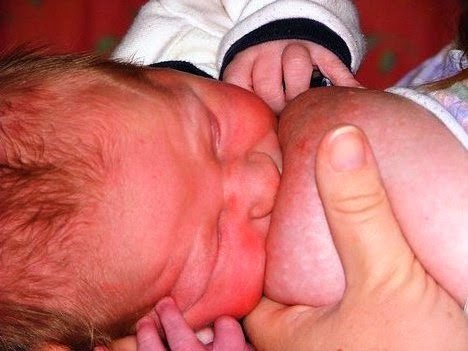
 

1. Hold the baby with one arm.
2. Hold the breast with the other, thumb on one side of the breast, your other fingers on the other, fairly far back from the nipple.
3. Watch for the baby's drinking, though there is no need to be obsessive about catching every suck. The baby gets substantial amounts of milk when he is drinking with an open-pause-close type of suck. (open-pause-close is one suck, the pause is not a pause between sucks).
4. When the baby is nibbling or no longer drinking with the open-pause-close type of suck, compress the breast. Not so hard that it hurts and try not to change the shape of the areola (the part of the breast near the baby's mouth). With the compression, the baby should start drinking again with the open-pause-close type of suck.
5. Keep the pressure up until the baby no longer drinks even with the compression, then release the pressure. Often the baby will stop sucking altogether when the pressure is released, but will start again shortly as milk starts to flow again. If the baby does not stop sucking with the release of pressure, wait a short time before compressing again.
6. The reason to release the pressure is to allow your hand to rest, and to allow milk to start flowing to the baby again. The baby, if he stops sucking when you release the pressure, will start again when he starts to taste milk.
7. When the baby starts sucking again, he may drink (open-pause-close). If not compress again as above.
8. Continue on the first side until the baby does not drink even with the compression. You should allow the baby to stay on the side for a short time longer, as you may occasionally get another letdown reflex and the baby will start drinking again, on his own. If the baby no longer drinks, however, allow him to come off or take him off the breast.
9. If the baby wants more, offer the other side and repeat the process.
10. You may wish, unless you have sore nipples, to switch sides back and forth in this way several times.
11. Work on improving the baby's latch.
The above works best, in our experience in the clinic, but if you find a way which works better at keeping the baby sucking with an open-pause-close type of suck, use whatever works best for you and your baby. As long as it does not hurt your breast to compress, and as long as the baby is "drinking" (open-pause-close type of suck), breast compression is working.
You will not always need to do this. As breastfeeding improves, you will able to let things happen naturally


Breast Compression. Revised January 1998 Written by Jack Newman, MD, FRCPC

Saturday, 1 February 2014

Getting a Good Start in Breastfeeding


11.     Starting Out Right
(a)    Prepare yourself mentally and physically, starting as early as during pregnancy.
     Gather as much information about pregnancy, childbirth and breastfeeding as you can through trusted resources. When you are well-equipped with knowledge, you will understand what you are going through, will know what to expect and will be able to plan how to deal with it. With 101 myths on motherhood and breastfeeding that community tend to spread around, knowledge serves as a shield to protect you against being deviated against breastfeeding.


      Start practising a healthy lifestyle like good eating, sleeping and exercise habits, to keep yourself healthy physically so that when your bundle of joy arrives, you will able provide him/her the best of care. Having said that, each mother is different so I am not able to touch on what I mean when I mentioned good eating/exercise habits because this varies from individual to individual. 


(b)    Equip yourself with appropriate breastfeeding tools
Yes mothers, I know how it feels when you go shopping for your expected newborn. Especially if it’s a girl! You would feel like grabbing all the gorgeous clothes from the racks. But trust me dear mothers, investing in proper equipments for breastfeeding is way much more important. I learnt this by mistake from my first pregnancy. I spent on clothes until some of the clothes my baby didn’t even get the chance to wear because she outgrew it! I didn’t even think of buying a breastpump, let alone other equipments at that moment. So, the outcome was, my breastfeeding attempt tallied to my breastfeeding effort, in which of course, I failed. Shame on me. We all learn from mistakes, I suppose. Anyway, I was more cautious during my second pregnancy, and prepared all the basic stuff needed for breastfeeding to work. 

It may be "expensive" to start out, but it is a once for all investment. If you do the math and calculate the price for formula milk for two years versus your one time investment for breastfeeding tools (which can last for two years if you care for it meticulously), breastfeeding is still cheaper. Another plus point in saving money is that breastfed babies have less hospital visits compared to formula fed babies.


(c)    Choosing the right hospital and informing hospital staffs regarding your wish to breastfeed.
Baby friendly hospitals are generally much more co-operative than those which are not. If you plan to deliver in a non-baby friendly hospital, inform the staffs beforehand regarding your wish to breastfeed. Make a tag stating `Fully Breastfeeding’ and as the nurse to stick in on your babies cot in the hospital nursery.

Having said all the above, I made mistakes with my two previous deliveries. I gave birth in a non-baby friendly hospital, thinking that all hospitals would support breastfeeding.  I literally had to beg the nurses to bring my baby to me for feeding. I was given weird stares by nurses when my baby cried after two hours of latching on the breast. I was given comments like `Oh, you are not producing enough for you baby, that’s why she’s crying after nursing on the breast. We will top up 2 ounces of formula feed for her’. Best part, my baby was just a day old at that moment. And poor me who was so determined to breastfeed became so devastated and confused that I didn’t have the will to fight for my right at that moment. I sincerely hope mothers out there learn from my mistakes and do not have to go through what I went through.


2.    Hard Work

Once you get home, continue nursing your baby directly as frequently as you can. Try to get the baby to latch on correctly to your breasts. This might take some time and patience, so do not give up if you failed the first few times. Try to start pumping as early as 1 week postpartum, whenever you have a break from the baby. If the baby wakes up while you are pumping, nurse him/her first then continue pumping. I know how tiring it can be to care for newborns, and I agree that mothers should take naps whenever baby is asleep. In that case, I may suggest nursing your child on one breast and pumping on the other side. This method can help prevent a mother becoming lopsided, help her build up her milk supply and help her prepare some milk stock (useful for working mothers when they get back to work).

-Have a method of monitoring your milk supply. Chart how much you pump a day and assess the baby’s intake in the form of weight gain, stool and urination.
-Breasts might not need cleaning after feeding, but if you are using the breastpump, all parts have to be cleansed and sterilized appropriately.
-Milk storage can also be a tideous process provided you have a system. Only store milk in bottles or bags meant for milk storage. Label the bottles/bags with date and time, so that first one in would be first one out.


3.    Consistency
 For working mothers, going back to work should not be a barrier for you to breastfeed. Discuss with your superiors regarding your need to pump at work. Plan your time and proper milk storage accordingly especially if your work involves a lot of travelling.


4.   Adequate support from surroundings
-This is one of the most difficult factor pertaining to making breastfeeding work. There are abundance of negativism, criticism and inappropriate so-called advices rather than optimism, encouragement and co-operation. Sad to say, sometimes our own closest family members are against breastfeeding.
-Do attend Breastfeeding Classes with your companion (eg husband, mother) or the person who is going to help take care of you during confinement and so forth. It might help them understand the support you need with regards to breastfeeding.


-Should you encounter any lactation problems, search for a lactation consultant to help you overcome those problems and never resort to formula milk right away.

-My advice to mothers out there, do not let others cause your high spirited will to breastfeed crumble or shatter your emotions into pieces. Stay strong and remember that you are doing this for your baby and you so it doesn’t matter what others perceive.

Sunday, 19 January 2014

Tandem Nursing

An Article on Tandem Nursing by Anna Smith (IBCLC).

The AAP (American Academy of Pediatrics) recommends exclusively breastfeeding your baby for the first six months of life, with no solids or supplements, and continuing to nurse throughout the first year of life and beyond. During the period of exclusive breastfeeding, it is very unlikely that you will become pregnant. However, as more and more mothers recognize the advantages of long-term nursing and natural weaning, more of them will become pregnant while they are nursing their baby.

The mother facing the decision of whether to wean or continue nursing during her pregnancy often has mixed emotions, and may get conflicting advice from friends, family, and health care providers. The most common concern is whether continuing to breastfeed will put the expected baby at risk in some way. There is no evidence to suggest that nursing while pregnant endangers the fetus during a normal pregnancy. If a mother has previously delivered a premature baby, develops signs of pre-term labor, or is carrying multiples, there is concern that a hormone released during lactation (oxytocin) may stimulate contractions and trigger a premature labor. In these special situations, mothers are often advised to wean their older child. Research suggests that the uterus is not receptive to hormonal stimulation from oxytocin until around 24 weeks gestation, so it is generally safe to consider nursing until about 20 weeks, even in these special situations. There is almost never a need to wean abruptly during pregnancy.


The mother who is deciding whether to continue nursing during her pregnancy has several factors to consider: her medical history, her physical and emotional comfort level, the nursing child’s age, and his need to nurse. If the pregnancy is progressing normally, then the decision of whether to continue to breastfeed is more an individual ‘parenting’ decision rather than a ‘medical’ decision.

Nursing During Pregnancy
There is no evidence that nursing during a pregnancy will cause miscarriage during the early months. Miscarriage occurs spontaneously in about 16-30 percent of all pregnancies, so it will sometimes happen while a mother is nursing. The nursing mother should not add the burden of guilt to the pain of losing a baby to miscarriage.

Nursing during pregnancy will not deprive the fetus of essential nutrients, and will not create a harmful “drain” on the mother’s body. During pregnancy, it is always important to eat nutritiously, gain weight appropriately, and get adequate rest. A well-nourished mother should have no problem providing enough nutrients for both her unborn baby and her nursing child.

Breastfeeding provides several opportunities each day for the expectant mother to take breaks and rest while her toddler nurses or naps.

Due to hormonal changes, most mothers will experience some degree of nipple soreness during pregnancy, which can make nursing very uncomfortable. Nipple soreness is the most common reason given for weaning during pregnancy. The soreness usually is most pronounced during the early months of pregnancy. Since the cause of the soreness is hormonal, there is no real treatment other than time. Some mothers find relief by reducing the time the baby spends at the breast, limiting nursing sessions to nap and bed-time,and others find that reminding the toddler to “open wide” while latching on may reduce soreness.

During pregnancy, most mother’s milk supply will decrease due to hormonal changes. During the second trimester, the milk will begin to change to colostrum. Both the quantity and the taste of the milk change dramatically during this time, and many babies will wean themselves when the milk changes. If you are nursing a baby younger than 6 months when you become pregnant, you will need to carefully monitor his growth and weight gain, and supplemental feedings may be necessary. Older babies who are eating solids will usually show an increased appetite for other foods as your milk supply decreases.

Some babies don’t seem to care whether they are getting a lot of milk when they nurse. That’s where the emotional component of breastfeeding becomes a factor. Babies vary in their need for oral satisfaction, physical contact, closeness to mother, and willingness to have those needs met in ways other than nursing.
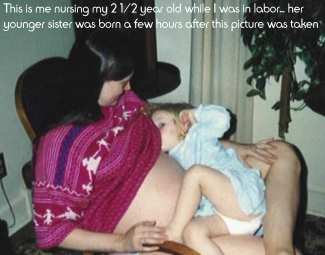
Some toddlers continue to find breastfeeding very important all the way through the pregnancy and after the birth of the new baby as well. Nursing siblings who are not twins is called “tandem nursing”. In our culture, this concept is unusual, although other in many other cultures it is a common practice. It is not unusual to have mixed feelings about nursing during pregnancy or tandem nursing. Negative feelings are common, due to physical discomfort and fatigue, as well as feeling “touched out” after nursing for so many months. For the mother who finds herself resenting the older baby’s demands, and has difficulty focusing enough attention on the new baby, weaning may be the best choice. She should try to wean gradually, nursing the new baby when the toddler is occupied with other things, and substituting special activities and snacks for nursings. Dads can be a big help with this process.

When they choose to tandem nurse, many mothers find that a unique closeness develops between their nursing siblings. Sharing at the breast can reduce the jealously and sibling rivalry that often accompanies the arrival of a new baby.

Because the older child is receiving nourishment from foods other than breastmilk, the newborn should be allowed to nurse first, ensuring that he gets lots of colostrum. Nursing a toddler can help relieve engorgement. Because the toddler will nurse more vigorously than the infant, the mother may find that she produces an oversupply of milk. If this occurs, and the newborn chokes when attempting to nurse, she may want to let the toddler nurse briefly before putting the new baby on the breast. Within a short period of time, the milk supply will adjust to the needs of the two siblings, just as it would if the mother were nursing twins or triplets. The two nurslings can be fed at the same time, or separately – whatever works best for you.


There are no special concerns about hygiene. The nipple secretes an enzyme that reduces bacterial counts, and breastfed babies are born with immunities to most germs found in their home environment. Most germs involved in common illnesses are contagious for days before symptoms appear, so tandem nursers have been exposed by the time you know one of them is ill. If you are dealing with a serious illness, one that is very contagious, or thrush, you may want to limit each child to one breast temporarily.

Sometimes a toddler who was weaned before the new baby’s arrival will decide that he wants to nurse again. Often a discussion of how he used to nurse, but now he’s a “big boy” and can eat grown up food, will suffice. If he is insistent about it, it is probably best to let him try. Most of the time toddlers who have weaned have forgotten how to nurse, and will lose interest quickly. Allowing him to nurse until he feels more secure about his new position in the family can be a good idea.

Tandem nursing is not for everyone. If it is not working out well, mothers should wean the older child without feeling guilty about it. It is important to give the older baby lots of extra cuddling and attention so that he knows that although he is losing the comfort and security of the breast, he is not losing his mother’s love.

If a mother does choose to tandem nurse, she can find it very gratifying for everyone involved. Knowing that she nursed her baby until he outgrew the need is a very rewarding feeling, and can result in increased security and self-esteem in the child who weans when he is ready to move on to the next stage of his development, and not just because his mother became pregnant.

(Edited October, 2013)
Anne Smith, IBCLC

Saturday, 11 January 2014

Fenugreek (as Milk Booster) During Pregnancy


Hi Mummies!

Recently I was approached by a Mummy who is Breastfeeding her 1 year and 3 months old child. She is also Pregnant with her second child (7 weeks POG).

She asked was it safe to take Fenugreek (As Milk Booster) during Pregnancy?


Fenugreek Seeds

Probably this few sentences from few resources would help summarize the answer:

"Fenugreek is LIKELY UNSAFE in pregnancy when used in amounts greater than those in food. It might cause early contractions. Taking fenugreek just before delivery may cause the newborn to have an unusual body odor, which could be confused with “maple syrup disease.” It does not appear to cause long-term effects."
Source:  http://www.webmd.com/vitamins-supplements/ingredientmono-733-FENUGREEK.aspx?activeIngredientId=733&activeIngredientName=FENUGREEK


"Avoid use in pregnancy as fenugreek has documented uterine stimulant effects. It has been used to stimulate milk production in nursing mothers. Excretion into milk has not been studied."
Source:  http://www.drugs.com/npc/fenugreek.html


"Traditionally, fenugreek has been used to stimulate labor. However, this does not mean that it is safe or effective for such use, since it has never been studied for such purposes. For instance, think about the many strange ways women try to induce labor (such as eating kiwi, eating spicy foods, or taking bumpy car rides). There is no real way to know if these methods are effective, even if they work. It could very easily just be coincidence.
Even though there is no research to suggest that fenugreek works for stimulating labor, it is a good idea to avoid taking it unless you are full-term (37 weeks pregnant or beyond). If fenugreek does happen to be effective for stimulating uterine contractions, which is currently unknown, it could cause preterm labor or miscarriages if taken earlier in pregnancy. Also, there have been reports of body or urine odor smelling like maple syrup in infants after fenugreek was used for labor stimulation (the herb contains a compound that smells like maple syrup). Sometimes, this is mistaken by medical providers as a rare but serious condition known as maple syrup disease.
Pregnancy is not a time to be experimenting with herbs or medications. It is best to stick with products that are known to be safe for pregnant women. As an herb that has been studied very little, fenugreek is not one of these products."
Note: The above are merely paragraphs taken from different resources. To read whole article, mummies may click on the links above.
Moral of The Story, Do Consult you Healthcare Proffesional before starting any Herbs/Supplements/Medications during Breastfeeding and Pregnancy :-)
Much LOVE <3

Tuesday, 7 January 2014

Breastfeeding May Prevent Arthritis: New Study

Adapted from:
http://www.thisisguernsey.com/news/uk-news/2014/01/07/breastfeeding-may-deter-arthritis/

Another Benefit for Mummies who Breastfeed :-)


Tuesday, 17 December 2013

Senarai Semak Untuk Ibu Bekerja

Lampiran di bawah ini adalah khas buat Ibu-Ibu tersayang yang ingin menyusukan anak dengan Penyusuan Susu Ibu walaupun sibuk bekerja. Adakah Ibu-Ibu sudah sedia? :-)

Lampiran ini adalah petikan dari Buku "Panduan Lengkap Bagi Ibu & Wanita Bekerjaya" terbitan Persatuan Penyokong-Penyokong Penyusuan Ibu & Bayi Malaysia.


Semoga berjaya Menyusukan Anak-anak dengan Susu Ibu! :-)